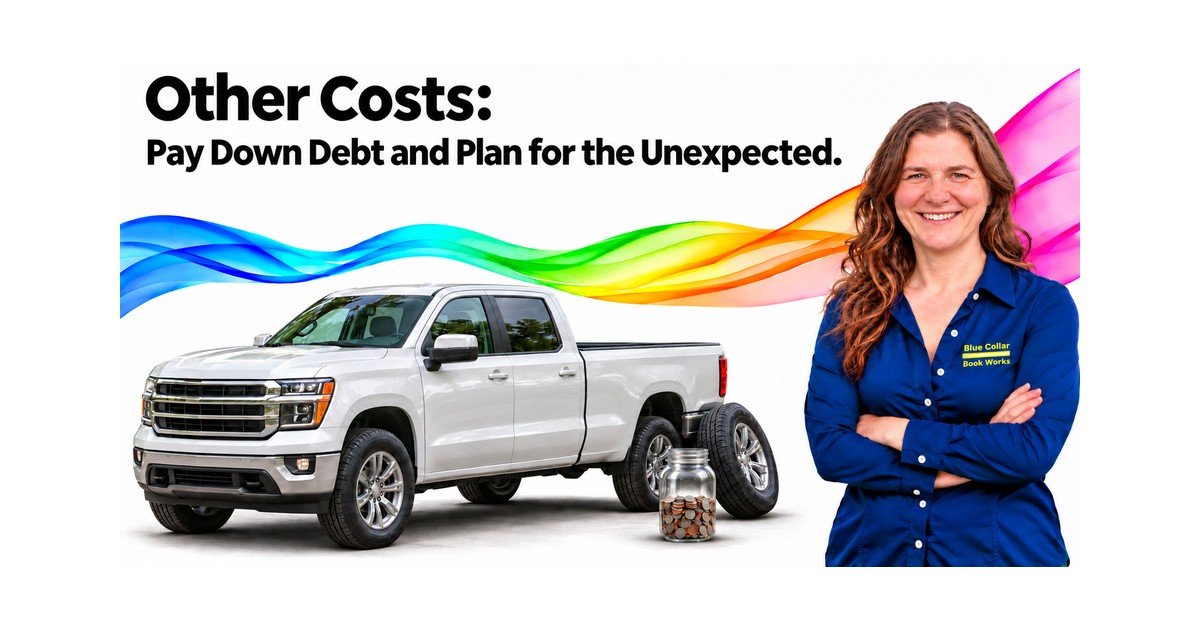
What would happen to your business if the truck’s transmission died in January? Or if you only ever paid the minimum on your line of credit? Those are the costs that sit quietly until they turn into a crisis. They’re the focus of the eighth and final pillar of the Cashflow Canvas: Other Costs. In this post, we put your debt and your “just in case” money into your cash flow, and we build a small business debt repayment plan.
In Pillar 7, we worked out what it costs to win a customer. Now we cover the last money going out: what you owe and what you set aside.
Other Costs covers contingency funds, loan payments, credit card and line of credit debt, and past due accounts. Most of us carry some debt in our business, so it needs a place in your cash flow. You may also hear loan payments called debt service, and a contingency fund called a rainy-day fund. Here’s the rule of thumb: if it’s a payment on money you already borrowed, or money you put away for the unexpected, it belongs here.
As before, we’ll follow our two example businesses: a roofing contractor and a wedding photographer. I made up every number for teaching, but the numbers tie together from one post to the next. All amounts are before GST.
Why a Small Business Debt Repayment Plan Matters
Debt payments are easy to forget when you plan, because they’re not part of the work. However, the bank doesn’t care whether you had a slow month. The payment still comes out.
The most common mistake is paying the minimum forever. For example, our roofer has $20,000 on his line of credit at about 9% interest. If he pays only the $500 minimum, it takes him about 4 years to clear it, and he pays about $3,870 in interest. That’s more than half of what one roof leaves him after direct costs.
The other common mistake is having no cushion at all. In other words, every surprise lands on the line of credit or the credit card. So a $3,000 repair turns into debt, and that debt costs interest for months.
This pillar can carry some emotional weight, because it’s where debt lives. That’s okay. The goal isn’t to make you feel bad about what you owe. Instead, it’s to put every payment where you can see it, so you can make a plan.
How a Small Business Debt Repayment Plan Protects Your Cash Flow
Debt payments come due every month, busy or not. Meanwhile, your income doesn’t come in evenly.
For example, take our roofer. Remember from Pillar 4 that only $15,000 comes in from November to February, and nothing at all in December or January. However, his $1,100 truck payment and his $500 line of credit minimum still come out every month. That’s $6,400 in debt payments over those four months alone. On top of that, as we saw in Pillar 5, his pay and his admin’s office time already cost more than that winter brings in.
Our photographer has a different pattern. Her retainers come in from January to April, months before the weddings. (A retainer is the deposit a couple pays to hold their date.) So her bank account looks healthy in the spring. However, that money belongs to weddings she hasn’t shot yet. As a result, she shouldn’t use it to pay off debt early. A better time for extra payments is late summer, after the wedding balances come in.
So for both of them, the question isn’t only “What do I owe?” It’s also “When do the payments land, and when can I afford to pay more?”
Step 1: Set Up Your Contingency Fund
First, decide how much to set aside for the unexpected. A contingency fund is money you put away for costs you didn’t budget for, like a blown truck tire or a broken lens. It’s a transfer to a savings account, not an expense. In other words, the money is still yours. You’ve just set it aside.
If you’re not sure how much to save, do a gut check and pick a percentage of your revenue. Something is better than nothing. Also, keep the fund in a separate savings account, so it doesn’t quietly get spent on regular bills.
Our roofer sets aside 2% of every deposit that comes in. That’s $12,000 over the year, or $1,000 in an average month. However, because he saves a percentage of what comes in, the transfer follows his season. It’s $2,100 in June and July, and $0 in December and January. That way, he saves the most when cash is flowing, and he isn’t forced to save in months with nothing coming in.
What This Looks Like for a Photographer
Our photographer also sets aside 2% of what comes in. That’s $2,730 over the year, or about $227.50 a month on average. For example, it’s $413 in July and August, and $63 in November.
She also has a second kind of savings. In Pillar 6, we promised to come back to her cameras. Her camera bodies and lenses wear out, and someday she’ll have to replace them. So she sets aside a flat $100 a month in a camera replacement fund. That’s $1,200 a year, or about $3,600 every three years toward new gear. Like the contingency fund, it’s a savings transfer, not an expense. Then, when the camera finally dies, the money is already there, and she doesn’t have to put it on a credit card.
Step 2: List Your Debts for Your Small Business Debt Repayment Plan
Next, list everything you owe. Your debts fall into three groups: revolving debt, instalment debt and past due accounts.
Revolving Debt
Revolving debt comes with a credit limit. You spend and repay as you choose, like a line of credit or a credit card. These make great targets for paying down faster, because there’s no penalty for paying more. In your cash flow, include at least the minimum payment on each one, as a floor.
Also, once you pay off a credit card, think twice before you cancel it. Your credit score depends partly on how long you’ve had your accounts. So closing an old account can lower your score.
Instalment Debt
Instalment debt has a fixed payment over a fixed period, like a truck loan or a loan for a new camera. Enter these payments straight into your cash flow, because they’re already set and hard to change.
Past Due Accounts
Past due accounts are bills you already owe and haven’t paid. For example, that could be a supplier invoice, or a GST or payroll remittance that has fallen behind. They belong in your cash flow too, because you still have to pay them. Also, late amounts can bring interest or penalties, so they’re often the first ones to clear.
Your Debt List: Where Your Small Business Debt Repayment Plan Starts
Now put it all in one table. For each debt, write down the balance, the interest rate and the monthly payment. Here’s our roofer:
| Debt | Type | Balance | Interest rate | Monthly payment |
|---|---|---|---|---|
| Truck loan | Instalment | $42,000 | About 7.9% | $1,100 (about 4 years left) |
| Line of credit | Revolving | $20,000 | About 9% | $500 minimum |
| Shingle supplier | Past due | $3,000 | None on the agreed plan | $1,000 a month for 3 months (April to June) |
And here’s our photographer:
| Debt | Type | Balance | Interest rate | Monthly payment |
|---|---|---|---|---|
| Camera loan | Instalment | $3,000 | About 8% | $100 (about 3 years left) |
| Credit card | Revolving | $1,000 | About 20% | $40 minimum |
Step 3: Put Every Payment in Your Cash Flow
Then add your other costs to your cash flow, month by month. Every loan payment has two parts. Interest is the cost of borrowing. Principal is the repayment of what you borrowed. In your cash flow, both are cash going out, so enter the full payment.
You might remember that in Pillar 2, we included interest in the price of a job. That’s the interest on materials you carry on credit until the customer pays you, and it helps set your price. Here, by contrast, we track the full payment leaving your bank account. One sets your price, and the other keeps you from running short. Still, be careful not to enter the same payment twice in your forecast.
Here’s the year for our roofer:
| Other cost | How it’s paid | For the year |
|---|---|---|
| Truck loan | $1,100 every month | $13,200 |
| Line of credit (minimum) | $500 every month | $6,000 |
| Supplier balance | $1,000 a month, April to June | $3,000 |
| Contingency fund | 2% of each deposit | $12,000 |
| Total | $34,200 |
That averages $2,850 a month. However, his busy months carry the most, because the contingency transfer follows his deposits.
What This Looks Like for a Photographer
Here’s our photographer’s year:
| Other cost | How it’s paid | For the year |
|---|---|---|
| Camera loan | $100 every month | $1,200 |
| Credit card (minimum) | $40 every month | $480 |
| Contingency fund | 2% of each deposit | $2,730 |
| Camera replacement fund | $100 every month | $1,200 |
| Total | $5,610 |
That averages $467.50 a month. It looks small next to the roofer’s. However, as we saw in Pillar 7, she only had $5,314.80 left to cover it.
Step 4: Build Your Small Business Debt Repayment Plan
Now that every payment sits in your cash flow, you can see how much room you have to pay more. That’s where a small business debt repayment plan comes in. The minimum keeps you current. The plan, on the other hand, gets you out.
Avalanche or Snowball: Order Your Small Business Debt Repayment Plan
Two common methods can set the order. The avalanche method pays the highest interest rate first, which costs you the least in interest. The snowball method pays the smallest balance first, which gives you quick wins. Either way, you keep paying the minimum on everything else, and both work far better than paying only minimums.
For our roofer, the two methods point in different directions. The avalanche says the line of credit comes first, because 9% is his highest rate. The snowball says the $3,000 supplier balance comes first, because it’s the smallest. In his case, he’s already clearing the supplier by June. So after that, both methods point to the line of credit.
Time Your Small Business Debt Repayment Plan to Your Busy Season
Here’s where revolving debt helps him. Because there’s no penalty for paying more, he can pay extra when the cash is flowing and drop back to the minimum in winter.
Say he pays $1,500 a month from May to October and the $500 minimum from November to April. Then he clears the $20,000 in about 22 months, and he pays about $1,860 in interest. That saves him roughly $2,000 compared with paying the minimum for 4 years. The extra $6,000 in the first year comes out of what he has left, which we’ll look at in Step 5.
What This Looks Like for a Photographer
For our photographer, both methods agree. Her credit card has the highest rate and the smallest balance, so it goes first.
If she pays only the $40 minimum, it takes her about 33 months to clear the $1,000, and it costs about $300 in interest. However, if she pays $100 a month, it’s gone in a year, and she pays about $100 in interest. That’s an extra $720 over the year. Right now, she doesn’t have it. Next year, as we’ll see in Step 5, she will.
Building the plan doesn’t have to be complicated. A simple debt repayment calculator does the math for you. Alternatively, I can help you build a small business debt repayment plan as a Cashflow Canvas certified coach. We’ll list all your debts with their interest rates and create a plan to pay them off. Consider how good it would feel to have all your debt gone. With a plan, it’s possible.
Step 5: Check What’s Left After Other Costs
Finally, take your other costs off what was left after Pillar 7. Here’s where our two businesses end up:
| Roofer | Photographer | |
|---|---|---|
| Left before debt and other costs (Pillar 7) | $90,502 | $5,314.80 |
| Minus other costs for the year | $34,200 | $5,610 |
| Cash left over after everything | $56,302 | −$295.20 |
| Share of revenue | About 9.4% | Short |
| Jobs needed to cover everything | 31 of 40 roofs | 40 of 39 weddings |
A quick note for the bookkeepers reading this: the contingency fund, the camera fund and the principal on each loan are cash going out, but they aren’t expenses. So the profit on the books is higher than the cash left over. For cash flow, though, cash left over is the number that matters.
Our roofer is in good shape. He keeps $56,302 after paying himself, covering every bill and saving for the unexpected. That’s enough room to pay down his line of credit faster and still have a cushion.
Our photographer, on the other hand, comes up $295.20 short. In Pillar 7, she needed 37 of her 39 weddings to cover her costs and her pay. Now, she would need 40, and she only books 39. In other words, at $3,500 a wedding, she can’t cover her pay, her bills, her debt and her savings.
The Fix: A New Price for Next Year
That’s not a reason to panic. Instead, it’s exactly what the Cashflow Canvas is built to show you while you still have time to act. Cutting costs won’t get her far enough. Even with no debt and no savings at all, she’d keep only about 3.9% of her revenue, with no cushion. So the answer is her price.
Remember from Pillar 3 that her competitors charge $2,500 to $4,500, and most sit around $3,500. Also, she offers real value: a second shooter at every wedding and a fast editing turnaround. So she raises her price to $3,800 for next year’s bookings.
Here’s what that $300 does. After the 2.5% merchant fee on the increase, she keeps $292.50 more per wedding, so each wedding now leaves her $2,445.70 after direct costs. Over 39 weddings, that’s $11,407.50 more for the year. Her contingency fund also grows by $234, because she’s saving 2% of a bigger number. As a result, she ends the year with $10,878.30 in cash left over, or about 7.3% of her revenue. Now she covers everything with 35 of her 39 weddings. Also, her 30% retainer rises to $1,140.
That’s enough to cover all her costs, pay herself a market wage, clear her credit card in a year and still have money left over. And she’s still within her market’s price range.
Putting It Together: The Whole Cashflow Canvas
Here’s the full year for both businesses, one pillar at a time:
| Pillar | Roofer | Photographer |
|---|---|---|
| 1. Revenue Streams (main stream) | Asphalt shingle roofs | Weddings |
| 2. Direct Costs (per job) | $8,985.40 | $1,346.80 |
| 3. Price Points (price, and left per job) | $15,000, leaves $6,014.60 | $3,500, leaves $2,153.20 |
| 4. Assumptions (jobs and revenue) | 40 roofs, $600,000 | 39 weddings, $136,500 |
| 5. Team + Personnel (owner wage and year-round staff) | $89,602 | $60,000 |
| 6. Space + Operating | $37,560 | $15,660 |
| 7. Marketing + Sales | $22,920 | $3,000 |
| 8. Other Costs | $34,200 | $5,610 |
| Cash left over after everything | $56,302 (9.4%) | −$295.20, then $10,878.30 (7.3%) at $3,800 |
So the roofer’s challenge is timing. His year works, but his debt payments land hardest in a winter with little coming in.
Meanwhile, the photographer’s challenge was her price. Without the full Canvas, she might have thought she just needed to work harder. Instead, she can see that her price, not her effort, was the gap.
Different businesses, same method.
Your Turn: A Quick Checklist
Before you finish your Canvas, here’s what you should have for your business:
- A contingency fund, with a set percentage of revenue going into a separate savings account
- Every debt in one list, with its balance, interest rate and monthly payment
- Every debt payment and savings transfer entered in your cash flow, in the month it actually leaves your account
- A small business debt repayment plan that pays more than the minimum on at least one debt
- Your cash left over after all 8 pillars, and what you’ll change if it’s too low
Glinda, the AI-powered Cashflow Canvas assistant, can walk you through listing your debts, setting your contingency fund and seeing how extra payments change your cash flow. If you want to try out Glinda for free, click here.
What’s Next: Putting Your Canvas to Work
This is the last pillar in the Cashflow Canvas, so the only thing left is to put it all together. If you’ve been working with Glinda all along, you’ll see your draft cash flow forecast. That’s your starting point.
However, keeping on top of your cash flow is a recurring task. So take time each month to review the plan and see where you’re on target and where you’re not. Then course correct in real time.
If you need help working through this process, please feel free to book a discovery call with me to see if we’re a fit to work together.



0 Comments